
AI CommerceJune 30, 20264 min read
A Retail Merchant's Funnel for Agentic Commerce
Most agentic commerce maps are built for investors. Redrawn as a merchant funnel—get found, get ready, get credit—the open ground is measurement.
By Satish Polisetti
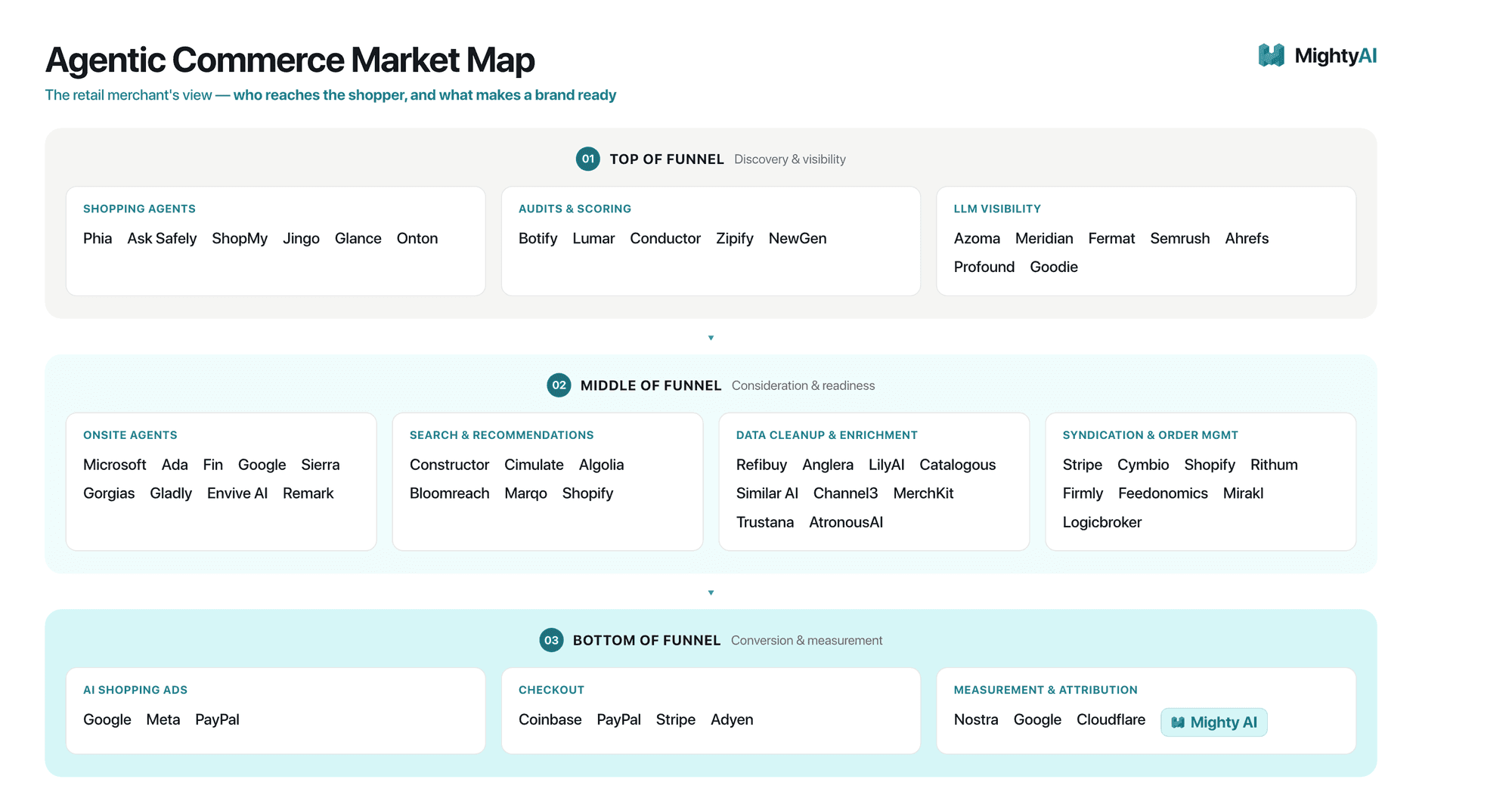
TL;DR Most agentic commerce maps are drawn for investors — territory, boxes, who's building what. Merchants think in a funnel: get found, get ready, get credit. Read the stack that way and the picture shifts. The effort to get found is now the easy part; the tooling is abundant. The open ground is the bottom of the funnel — conversion, and the measurement that has to come before any of it can be optimized.
Why a funnel, not a market map
Bessemer's recent agentic commerce map is a sharp piece of work — but it's drawn from the buyer's side, around the delegated agent doing the shopping. Useful for deciding where to invest. Less useful for a merchant deciding where to spend the next quarter.
Merchants read everything as a funnel. Discovery, consideration, conversion. So I redrew it from the retail merchant's seat, organized by funnel stage — so a merchant can take the vendors they're already talking to and see which stage each one actually helps with.
Top of funnel — Get found (discovery and visibility)
This is the get found layer, and it splits into three parts.
Shopping agents are the assistants shoppers actually browse and buy through — and they're going vertical. Alongside the horizontal assistants everyone knows, a wave of category-specific agents is emerging for fashion, beauty, home, and more, each with its own audience. The merchant question is concrete: which of these cover my category, and does my catalog surface inside them?
Audits and scoring tools grade how discoverable a brand is — crawling the site, checking structured data, and flagging what's stopping an agent from cleanly reading the catalog. This is the diagnostic layer: it tells a merchant where the gaps are before an agent finds them.
LLM visibility tooling reveals whether ChatGPT, Perplexity, and AI Overviews actually mention the brand — and how they describe it. Think of it as share-of-voice for the AI answer: not just am I showing up, but what's being said when I do.
Here's the good news, and it's genuinely good: across all three, this layer is well served. For a merchant whose job is to be discoverable by an AI agent, there's no shortage of ways to measure it and improve it.
Middle of funnel — Get ready (consideration and readiness)
This is the get ready layer, and it splits into four parts.
Onsite agents are the conversational assistants on the merchant's own site — greeting a shopper, answering questions, nudging them toward the right product. They sit where two once-separate jobs are collapsing into one: pre-sales guidance and customer support. The agent that helps a shopper choose increasingly handles the return too.
Search and recommendations engines decide which products surface for a given query, personalizing on two signals at once: what the shopper is asking and what their clickstream shows they're doing. The line with onsite agents is blurring fast — the vendors overlap, and a recommendation engine wrapped in a conversational layer is, functionally, an onsite agent. Treat them as one job with two front doors.
Data cleanup and enrichment tools do the unglamorous work that makes everything else possible — normalizing attributes, filling gaps, turning a messy catalog into something an agent can read. It's also where the most human-in-the-loop judgment is still required; no tool makes these calls cleanly on its own.
Syndication and order management plumbing carries that clean catalog everywhere an agent might look and handles the mechanics once an order lands. It's the connective tissue that keeps a brand consistent across every surface — and notably, it's pulling in players that used to sit elsewhere. Payment and platform incumbents like Stripe and Shopify are moving into syndication, a space they largely left alone before.
This layer is where a merchant's work actually differentiates. Done well, the wins cross-pollinate: the same clean, structured data that lifts onsite search also travels offsite to the agents and answer surfaces upstream. Get it right once and it pays off in both directions.
Bottom of funnel — Get credit (conversion and measurement)
This is the get credit layer, and it splits into three parts.
AI shopping ads are the paid surfaces inside agentic experiences, and they aren't all the same shape. The most native versions place a recommendation inside the answer itself, like Google's announcements at Marketing Live 2026. Others, like PayPal's, are faster-checkout ads bolted closer to the transaction. ChatGPT is opening its own ad surface too, though by the test I laid out in Native Ads, Round Three, it isn't truly native yet. Early, fast-moving, and still sorting itself out.
Checkout is the agentic payment layer that lets a shopper complete the purchase without leaving the conversation. The rails here are being built quickly, and this is the part of the bottom that's maturing fastest.
Measurement and attribution answers the only question that ties the whole funnel together — did any of it work? Which agent drove the sale, which of the upstream investments paid off, what the AI channel is actually worth.
Consider the sequence a merchant is living through right now. The work to get found is done. The data is cleaned to get picked. An agent recommends the brand, a shopper converts — and then the session lands in analytics as "direct." It can't be seen. It can't be attributed. There's no way to tell which of the two layers above actually paid off.
What a merchant should actually do
-
Set a baseline before optimizing anything. If AI traffic is under 5% of sessions today, a merchant is behind; 15–20% and they're ahead. Neither is knowable without capturing it — and most analytics misclassify it as direct. Fix the measurement first.
-
Enrich product data. This is the get-ready work that makes the get-found work pay off. True, specific, shopper-useful fields — editorial, not keyword-stuffed. Agents penalize inflation and reward clarity.
-
Instrument the bottom of the funnel for attribution. Track AI-referred and AI-influenced conversions as their own thing, and map them to revenue and AOV. That delta — not raw traffic — is the real signal of whether the AI channel is working.
-
Then, and only then, optimize. Ads, bidding, syndication, spend allocation — all of it gets smarter once it can be measured. Optimization without measurement is just a more expensive guess.
The bottom line
Everyone is optimizing to get found. Almost no one can trace it all the way to revenue.
MightyAI is helping merchants measure the AI channel first. Because a channel that can't be seen can't be optimized — and right now, the merchants who can see it have a structural head start.
This map is a living document. If a company belongs on it and isn't — or is placed wrong — let us know. We update it as the space moves.