
Ads AgentOctober 22, 20265 min read
Goals, Not Campaigns: What Meta Ads Will Look Like in 2027, From Meta's Own Product Lead
Meta's product lead laid out what's coming to Meta ads in 2027, and what it means for brands choosing an agent to manage Meta ads.
By Satish Polisetti
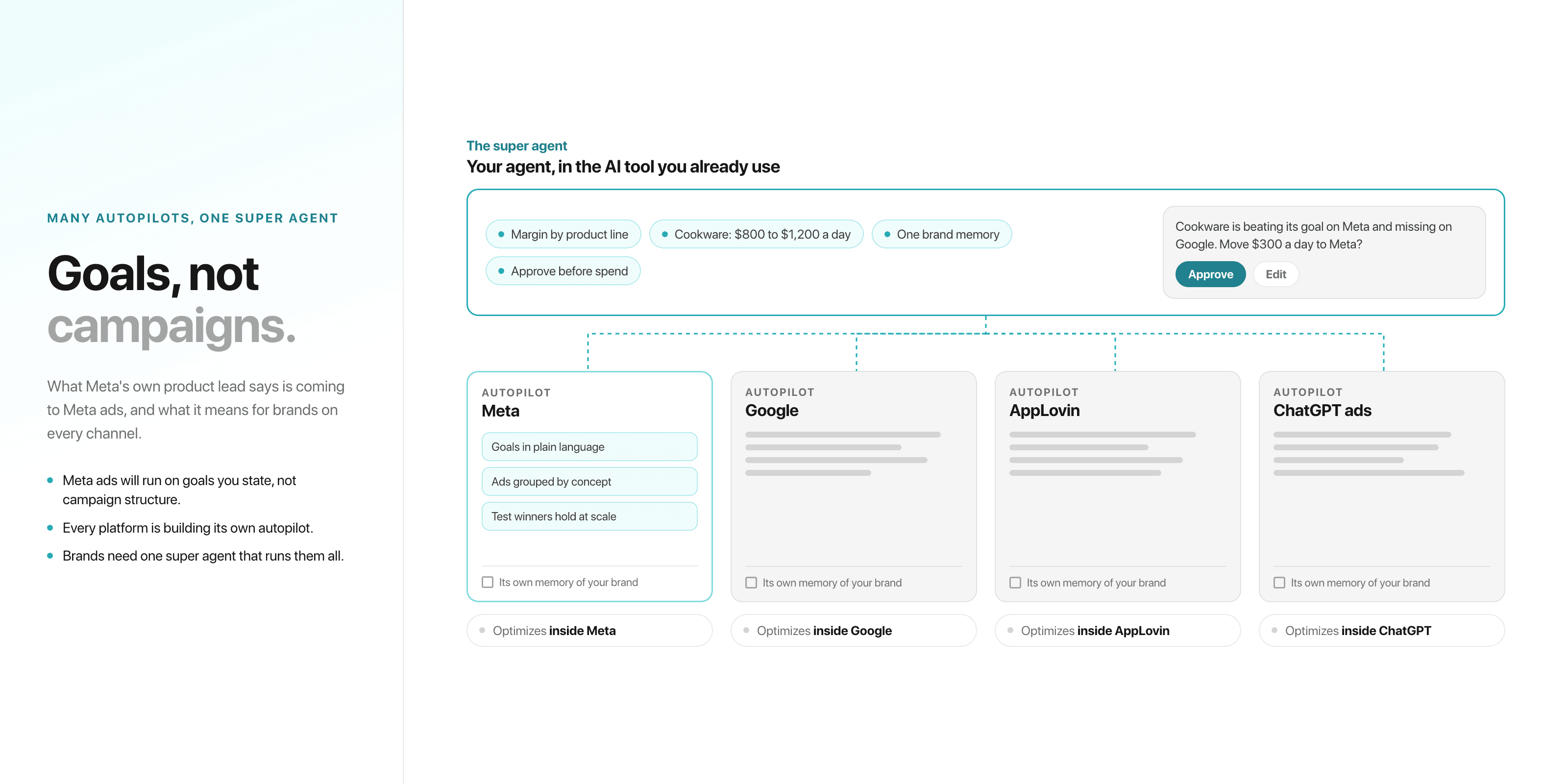
TL;DR Meta's product lead for ads automation just laid out what's coming: goals instead of campaign structure, Meta showing you which of your ads it thinks are the same ad, and test winners that hold up at scale. Each platform is building an autopilot for its own channel; brands on more than one channel need a super agent that runs all of them.
On October 16, Nik Ketkar, a director of product management at Meta, sat down with the hosts of Marketing Operators at Meta's New York office to walk through where Meta's ads automation is going.
I listened to the full hour so you don't have to. Nik put no dates on any of it; a few pieces are rolling out now and the rest is where Meta says it's heading. My read: most of it lands in 2027.
What's coming to Meta ads
His frame: a media buyer's week used to be half execution and half strategy. Meta wants it to be all strategy. Four things stood out.
Goals replace campaign structure. His example was a brand selling socks and shoes: different margins, different order values, one account. You'll state that in plain language, with hard and soft budget limits per product line or country, and set goals across a group of campaigns rather than one at a time. Brands have built campaigns, ad sets and ads to mirror their business. Those layers stop being how you steer.
Meta will show you which of your ads it thinks are the same ad. Brands have been told for years to make their creative diverse, without ever seeing what Meta counts as diverse. Ads Creative Studio groups your ads by concept and shows which concepts are working against your category.
Test winners keep their learning when they scale. Every buyer knows the creative that wins a test and stalls in the scaling campaign. Meta says it will run the test for you, recommend the budget, and carry what the winner learned into the campaign that scales it.
Margin is already in; inventory may be next. One of the hosts said Meta already takes in cost data, so brands can bid on margin rather than revenue, and Nik listed margins among the goals you'll set across a group of campaigns. The open question is inventory: the host asked whether stock levels become an input, and Nik didn't commit. If they do, Meta stops spending on products you can't ship.
Many autopilots, one super agent
None of this is bad for brands. Use it. Here is the model I carry away from the episode.
Every platform is building an autopilot, and each works for its own platform. Google, AppLovin and ChatGPT ads are building their own. Meta's will move budget between Meta campaigns. It will never tell you the next dollar belongs on Google.
Each keeps its own memory. Meta is building brand memory too: your logos, voice and tone, plus which concepts win. What it learns about your brand stays on Meta. Four channels means four partial memories of the same brand.
The brand needs a super agent. One agent to manage Meta ads and every other channel: it connects each platform's autopilot, sets the goals once, keeps one memory, and decides where the money goes.
That's the super agent we're building. MightyAI agents manage Meta ads, Google Ads, AppLovin and ChatGPT ads for DTC brands on Shopify, toward one set of goals, with your approval before anything spends. You work with them from the AI tool you already use, whether that's Claude, ChatGPT or Codex.
How to get ready
-
Translate your account structure into sentences. Every campaign split exists for a reason: this line has to grow, Germany has its own P&L, gifting can run at a lower ROAS in December. Today those reasons live in your media buyer's head. Write them down, one sentence each. That page is what Meta's goals will ask for, and every other platform's will too.
-
Decide what you'll approve and what you won't. As more of the work runs itself, approving becomes the job. Decide now which changes you want to see, such as budget jumps, new audiences or new claims in creative, and which can just run. Otherwise you'll approve everything blindly or become the bottleneck.
-
Keep the memory outside the platform. Meta will learn which concepts win for your brand, and that stays on Meta. Keep your own record of what you tested, why, and what happened, in the AI tool you already use, so it carries across channels, agencies and hires.
Meta just told us its ads will run on goals, not campaigns, and every platform will follow. The question is who sets the goals across all of them. Every platform is building an autopilot. Which agent works for you?
Questions brands ask
Can an AI agent manage Meta ads today? Yes. Meta's automation runs more of the setup every year; an agent working for the brand sets the goals, approves the changes, and splits spend across channels.
Will Meta's automation replace an ads agent? No. It runs inside Meta, so it won't move budget to Google, AppLovin or ChatGPT ads, and what it learns stays on Meta.
Is an ads agent a replacement for an agency? For running the loop, yes. The research, creative, launches and reporting an agency does in weekly sprints, an agent does continuously, with you approving before anything spends.
Corrections and disagreements to satish@mightyai.app.